






Inositol for fertility: Evidence, opinions and controversy at Fertility 2026

Fertility is the UK’s leading medical conference on fertility science. Every year, leading fertility clinicians, embryologists and researchers from across the UK meet to discuss the latest findings and controversies. This January, Fertility 2026 was held in Edinburgh and the UK team of Procare Health spent three days there.
The inositol controversy in the UK
The Procare team talked to experts from leading NHS and private fertility clinics in the country and are reporting on one of the most interesting topics – the controversy around inositols.
Inositols are naturally-occurring sugars, which have been shown to be a valuable alternative to metformin for treating fertility problems in women with polycystic ovary syndrome, or PCOS. The two forms of inositols used in fertility treatment are myo-inositol and D-chiro-inositol.
The Procare team discovered that there is a group of hospitals where inositols are not used at all due to what they describe as ‘lack of sufficient evidence’. Yet in other hospitals, myo-inositols are prescribed for patients with PCOS. In a small number of hospitals, a combination of myo-inositol and D-chiro-inositol is used, again, primarily for PCOS patients to treat the condition and improve their chances of pregnancy.
D-chiro-inositol for insulin control
Many women with PCOS are resistant to the action of insulin, and produce more as the body’s way of combating this. There is also a large number of women who do not have PCOS but suffer from insulin resistance. This poor response to insulin leads to excess insulin and can affect fertility.
Insulin stimulates the liver and muscles to take up sugar in the form of glucose from the blood. It thus reduces blood sugar levels and creates energy stores in the form of glycogen. D-chiro-inositol mimics role of insulin in the body, so the body produces less insulin as a result. Insulin control is a challenge among women with PCOS, those over 40 and women with high BMI. Therefore, having a good level of D-chiro-inositol in the body is thought to indirectly help insulin control.
Healthy women can make the D-chiro-inositol they need from myo-inositol. But women with PCOS or insulin resistance cannot do this well. As a result they are deficient in D-chiro-inositol, even if they have sufficient levels of myo-inositol.
History of inositol use in Europe
Inositols have only been used to support women’s fertility relatively recently. Myo-inositol was first used in 2007 for PCOS with the aim of supporting D-chiro-inositol production. However, myo-inositol alone had little effect in improving pregnancy rates. Now we know why. The body’s ability to process myo-inositol to produce D-chiro-inositol is essential for insulin control and hormone regulation. Given that women with PCOS struggle to produce the vital D-chiro-inositol from myo-inositol, it is no surprise that supplementing myo-inositol alone did not significantly improve their fertility.
With this new understanding, in 2012, clinicians started using a combination of myo-inositol and D-chiro-inositol to help PCOS patients with their fertility. Initially, scientists used myo- and D-chiro-inositol at the ratio of 1000mg: 25mg per day. This was based on the level found in the blood of healthy patients. In 2019, some scientists started to investigate whether a 300mg daily dose of D-chiro-inositol, rather than 25mg, would be more effective. 300mg is based on the amount of D-chiro-inositol that healthy women are thought to produce every day.
In one clinical study, 300mg proved to be highly effective in improving the pregnancy rate among PCOS patients compared to the 25mg dose (1). In another clinical study, a 300mg daily dose led to significantly better egg quality compared to a 25mg daily dose (2).
Ovosicare Fertility: based on the latest inositol science
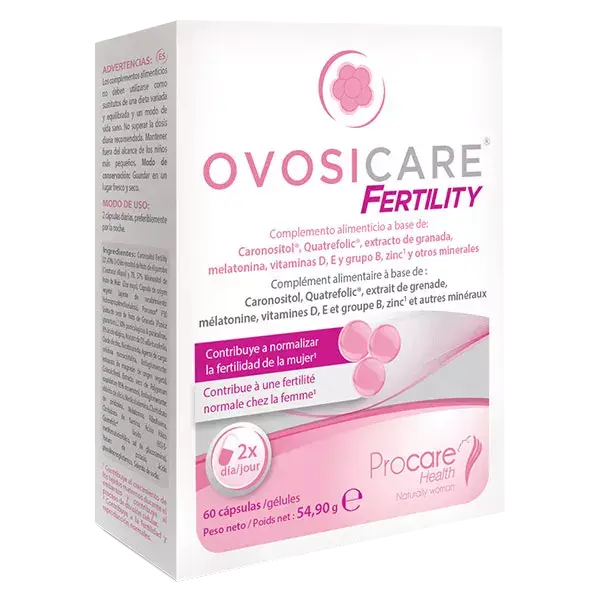
Based on this latest evidence, in 2022 Procare developed Ovosicare Fertility, a food supplement for women trying for a baby. It contains 1100mg of myo-inositol and 300mg of D-chiro-inositol, the exact amount that has been tested in the two studies described above.
Procare launched Ovosicare Fertility first in Spain, where clinicians were already using myo- and D-chiro-inositol together. Ovosciare Fertility’s formula was well accepted and it is now one of the two leading pregnancy supplements.
Supporting evidence-based discussion on D-chiro-inositol use
Procare introduced Ovosicare Fertility to the UK two years ago. The clinical practice in relation to inositol varies widely, as we confirmed talking to experts from hospitals
across the UK. Our Procare team is now highly motivated to provide evidence and facilitate the discussion on the use of inositols, in particular the 300mg dose of D-chiro-inositol for women with PCOS and insulin resistance.
1 https://www.tandfonline.com/doi/full/10.1080/09513590.2019.1576620
2 https://www.tandfonline.com/doi/full/10.1080/09513590.2019.1681959
Fertility is the UK’s leading medical conference on fertility science. Every year, leading fertility clinicians, embryologists and researchers from across the UK meet to discuss the latest findings and controversies. This January, Fertility 2026 was held in Edinburgh and the UK team of Procare Health spent three days there.
The inositol controversy in the UK
The Procare team talked to experts from leading NHS and private fertility clinics in the country and are reporting on one of the most interesting topics – the controversy around inositols.
Inositols are naturally-occurring sugars, which have been shown to be a valuable alternative to metformin for treating fertility problems in women with polycystic ovary syndrome, or PCOS. The two forms of inositols used in fertility treatment are myo-inositol and D-chiro-inositol.
The Procare team discovered that there is a group of hospitals where inositols are not used at all due to what they describe as ‘lack of sufficient evidence’. Yet in other hospitals, myo-inositols are prescribed for patients with PCOS. In a small number of hospitals, a combination of myo-inositol and D-chiro-inositol is used, again, primarily for PCOS patients to treat the condition and improve their chances of pregnancy.
D-chiro-inositol for insulin control
Many women with PCOS are resistant to the action of insulin, and produce more as the body’s way of combating this. There is also a large number of women who do not have PCOS but suffer from insulin resistance. This poor response to insulin leads to excess insulin and can affect fertility.
Insulin stimulates the liver and muscles to take up sugar in the form of glucose from the blood. It thus reduces blood sugar levels and creates energy stores in the form of glycogen. D-chiro-inositol mimics role of insulin in the body, so the body produces less insulin as a result. Insulin control is a challenge among women with PCOS, those over 40 and women with high BMI. Therefore, having a good level of D-chiro-inositol in the body is thought to indirectly help insulin control.
Healthy women can make the D-chiro-inositol they need from myo-inositol. But women with PCOS or insulin resistance cannot do this well. As a result they are deficient in D-chiro-inositol, even if they have sufficient levels of myo-inositol.
History of inositol use in Europe
Inositols have only been used to support women’s fertility relatively recently. Myo-inositol was first used in 2007 for PCOS with the aim of supporting D-chiro-inositol production. However, myo-inositol alone had little effect in improving pregnancy rates. Now we know why. The body’s ability to process myo-inositol to produce D-chiro-inositol is essential for insulin control and hormone regulation. Given that women with PCOS struggle to produce the vital D-chiro-inositol from myo-inositol, it is no surprise that supplementing myo-inositol alone did not significantly improve their fertility.
With this new understanding, in 2012, clinicians started using a combination of myo-inositol and D-chiro-inositol to help PCOS patients with their fertility. Initially, scientists used myo- and D-chiro-inositol at the ratio of 1000mg: 25mg per day. This was based on the level found in the blood of healthy patients. In 2019, some scientists started to investigate whether a 300mg daily dose of D-chiro-inositol, rather than 25mg, would be more effective. 300mg is based on the amount of D-chiro-inositol that healthy women are thought to produce every day.
In one clinical study, 300mg proved to be highly effective in improving the pregnancy rate among PCOS patients compared to the 25mg dose (1). In another clinical study, a 300mg daily dose led to significantly better egg quality compared to a 25mg daily dose (2).
Ovosicare Fertility: based on the latest inositol science
Based on this latest evidence, in 2022 Procare developed Ovosicare Fertility, a food supplement for women trying for a baby. It contains 1100mg of myo-inositol and 300mg of D-chiro-inositol, the exact amount that has been tested in the two studies described above.
Procare launched Ovosicare Fertility first in Spain, where clinicians were already using myo- and D-chiro-inositol together. Ovosciare Fertility’s formula was well accepted and it is now one of the two leading pregnancy supplements.
Supporting evidence-based discussion on D-chiro-inositol use
Procare introduced Ovosicare Fertility to the UK two years ago. The clinical practice in relation to inositol varies widely, as we confirmed talking to experts from hospitals
across the UK. Our Procare team is now highly motivated to provide evidence and facilitate the discussion on the use of inositols, in particular the 300mg dose of D-chiro-inositol for women with PCOS and insulin resistance.
1 https://www.tandfonline.com/doi/full/10.1080/09513590.2019.1576620
2 https://www.tandfonline.com/doi/full/10.1080/09513590.2019.1681959

Social
Sign up to receive our newsletter and a welcome discount code:
Disclaimer: Information on this website is provided for informational purposes only and not intended as a substitute for the advice provided by your physician or other healthcare professional. You should not use the information on this website for diagnosing or treating a health problem or disease, or prescribing any medication or other treatment. For medical advice, diagnosis and prescription, please consult a healthcare professional. More Information >
Disclaimer: Information on this website is provided for informational purposes only and not intended as a substitute for the advice provided by your physician or other healthcare professional. You should not use the information on this website for diagnosing or treating a health problem or disease, or prescribing any medication or other treatment. For medical advice, diagnosis and prescription, please consult a healthcare professional.
© LivBio Limited 2024 All Rights Reserved.
